Showing posts with label Salem. Show all posts

Monday, May 7, 2007

Books & Their Covers

Amongst the legions of peace activists who participated in yesterday's march, there were around 6 or 7 young people who wore bandannas over their faces and some even worse sunglasses. The police kept a very close eye on this group. Why? Solely because of the way they dressed.

When I was young, my parents taught me a maxim that I'm certain most every other parent teaches their children as well -- You shouldn't judge a book by its cover. In other words, you shouldn't allow superficial observations to color your ultimate judgment of a person or situation. Yet this is precisely what the police were/are doing.

Not jumping to quick conclusions seems to be a hard task for all of us. We take a quick glance at a particular circumstance and immediately formulate an opinion. There's nothing wrong with this UNLESS we allow our partial formulation to solidify into a hardcore final analysis. By doing this, we often cast aside pertinent information and further observation that might very well change our overall attitude about our snap judgment.

I've met many, many people who I initially disliked. The first time I encountered one of my best friends from Salem, he was berating a candidate that I served as campaign manager for. He ranted, raved and fumed about what he thought was wrong with the focus of the campaign message.

If I had allowed my knee jerk reaction to govern my final view of this man, I never would have gotten to know him. I never would have discovered his wry sense of humor, his devotion to his wife and children, his commitment to education (he's a history prof at Willamette University) or his dedication to public service. In essence, someone who has turned out to be one of my dearest friends would have remained a stranger to me!

As our march and rally wound down yesterday, I went up to thank each of these youth for their participation. With bandannas removed, I saw youthful faces not unlike countless other faces in the crowd. These young people were no more a threat to "public order" than any other attendee there.

Still, I will admit to the world that there was a time not so long ago when I made the same mistake as the police. Maybe it's a generational thing. As an organizer with Oregon PeaceWorks, I worked with a lot of the so-called street youth in Salem.

I was initially put off by all these young people with weirdly colored hair, dog collars around their necks, ball bearings stapled in their tongues and piercings and body jewelry adorning almost every inch of their bodies. Fortunately, I was able to cast off my "older guy" prejudices and work with these kids on a daily basis. In time, I realized how silly my snap judgments were. Their piercings were nothing more revolutionary than the long hair of my youth.

In this same vein, bandannas covering one's face both is a social and political statement. No more, no less. It certainly doesn't mean that such individuals are prone to violence anymore than anyone else is.

I'm glad these young people came to help us in this protest and I will welcome them with open arms at any future such event. I also hope that local law enforcement personnel will try to remember the lesson they too learned so many years ago as children -- Don't judge a book by its cover.

Wednesday, December 27, 2006

All Wet

When my wife & I moved to Aberdeen from Salem, people told us to be prepared for more rain. That was quite okay with us as we like the rain. Still, this year has been phenomenal. Eighty inches per year is not atypical, but this year -- even for soggy Aberdeen -- it seems we've set a waterlogged record.

We passed 100" for the year two days ago! That's a lot of rain, folks. And there's still a few days and at least one more storm to go.

The stats themselves mean nothing, but it certainly does illustrate how a difference in climate can alter one's outlook or daily routine. When we lived in Pendleton, 14 inches of precipitation for the year -- most of that in the form of snow -- was considered a deluge. We received nearly that amount -- almost ALL in rain -- last January.

Sunday, June 4, 2006

Both Sides Now

One of the stories making the news in this area --– across the nation too --– was the week long anti-war protests at the Port of Olympia over the past few days. The impetus for the protests occurred when military convoys arrived and the U.S. Naval Ship Pomeroy docked to transport the equipment overseas.

One of Olympia'’s City Council members attended many of the demonstrations as an observer. He was later castigated by many in the community. One of the many critiques came from a military veteran. Upon learning that said Council member had never served in the armed forces, this person wrote in an email, "When it comes to war, leave it alone. I read your biography and notice you never served. This doesn't surprise me since about 95 percent of protesters haven't."”

This comment harkened me back to Salem, Oregon, 2 or 3 years ago. I was standing on a downtown street corner holding a sign protesting the war in Iraq. A gentleman came up to me and asked if I had ever served my country in the armed forces. No, not me, I replied. He then launched into the same kind of diatribe.

I just smiled at him. I found his comments amusing. He was stomping around telling me that no veteran would be wasting their time as I was. Unbeknownst to this gentleman, the two men standing on either side of me were indeed veterans, one having served several tours in Vietnam and the other served in Desert Storm. Both were vocal critics against the war in Iraq.

This incident underscored for me the fact that people jump to too many conclusions on how THEY believe a particular person might feel about any given subject. Just because an individual is a military veteran does not mean they will be in favor or against our current military endeavors.

While many current anti-war protestors have never served a second in military service, this same fact is also true of the vast majority of the individuals who support the war!! It's very apparent then that military service does not, in and of itself, determine a person'’s point of view.

This is equally true for almost any topic one can think of. There are many Republicans who have become outspoken critics of the Bush Administration and it seems just as many Democrats who vote the Bush line.

In fact, from my perspective, one of the greatest examples of a person'’s political position not seeming to match up with their "“label"” is borne out by Gay Republicans.

That one is hard for me to wrap my brain around!

Sunday, May 7, 2006

Cruise 'N the Harbor

One of the big differences between living in a small town versus a small city (Salem) or a large metropolis like Chicago or New York City can be found on the front pages of the area newspaper. (Of course, another difference is the number of newspapers itself.)

The big story in Aberdeen's The Daily World is of no international or national significance. It isn't political or scientific. No, the BIG story that has predominated our front page for the past 5 days and will continue to show up there until, at least, Wednesday is that movie actor Tom Cruise is coming to Aberdeen.

It seems a local man won some on line contest in which he will get to see a private screening of the latest Mission Impossible flick with the star himself. The screening will take place at our half-dead South Shore Mall on Tuesday. People from as far away as Portland and Seattle plan to descend on our area to catch a glimpse of this so-called sex symbol.

I suppose the excitement is understandable. Towns like Aberdeen -- far off the beaten path -- aren't used to feting movie stars and the like. Heck, it's a big deal when the governor or a member of the Seattle Mariners comes to town. Still, Tom Cruise is just a guy who acts in movies. It's not like he's an important role model or world leader.

It amazes me what seems to excite people. I know I certainly won't alter my general routine come Tuesday night.

Saturday, January 7, 2006

A Pocket of Overflowing Zeroes

Back in 2003, I led an effort before the Salem (Oregon) City Council to denounce Bush's plan to conduct a pre-emptive attack on Iraq. Over 180 citizens turned out to provide support and/or testify on the resolution presented. Not only did we make front page news in the Statesman Journal, but our effort was featured on PBS's News Hour with Jim Lehrer. (You can watch the streaming video here.)

Besides the event at City Council, many of us wrote letters to the editor. One of the points we hammered on was the potential cost to American taxpayers. We pointed out repeatedly that conservative estimates placed the price tag somewhere in the range of $100 - $200 million.

Well, you can guess what the response was from Bush supporters. "Those liberals are being overdramatic." "They're just trying to whip up hysteria." "It won't cost anywhere near that much and they damn well know it." "The president says it will cost far less and I believe he's being candid and honest." On and on and on.

According to an article in yesterday's Guardian, we hysterical liberals were indeed wrong! The "war" in Iraq isn't going to cost American taxpayers $100 - $200 million -- No, the bill will wind up being $1 - $2 TRILLION!!
The real cost to the US of the Iraq war is likely to be between $1 trillion and $2 trillion), up to 10 times more than previously thought, according to a report written by a Nobel prize-winning economist and a Harvard budget expert.

The study, which expanded on traditional estimates by including such costs as lifetime disability and healthcare for troops injured in the conflict as well as the impact on the American economy, concluded that the US government is continuing to underestimate the cost of the war.
Seems we weren't so hysterical after all.

Wednesday, December 28, 2005

Whew! I'm Out of the Dog's House

Most people base opinions on some manner of a factual basis. While it's certainly true that we all are guilty of picking and choosing which facts we choose to utilize, it's still typical that SOME manner of fact is involved. This cannot be said for the blog, Where's Your Brain?.

As I've discussed here before, facts seem to irritate that blog's author to know end. Not only does it irritate her, but she has a penchant for removing fact-based comments from her posts.

Yesterday she slipped up somewhat by allowing me to post a comment. (She forgot that I had moved from Oregon to Washington and this meant she needed to change the IP address to be blocked.) In her entry of December 22, "A Merry Christmas -- Spy vs Spy", one paragraph states,
I have to admit I do a little of my own spying - like checking if people leaving hate comments on my blog are really that same person as someone else. I haven't had hate comments for many months - not since I exposed this jerk from Portland. He was coming in with the exact same IP address as others (with similar hate styles) yet claimed it wasn't him. So I banned his IP and BINGO - suddenly about 3 identities no longer posted.
Here was my response
You wrote: "I have to admit I do a little of my own spying - like checking if people leaving hate comments on my blog are really that same person as someone else. I haven't had hate comments for many months - not since I exposed this jerk from Portland. He was coming in with the exact same IP address as others (with similar hate styles) yet claimed it wasn't him. So I banned his IP and BINGO - suddenly about 3 identities no longer posted."

So, how many of us "jerks" have you banned? I know that I'm on your doggie "no no" list. However, since the person you refer to in this entry hails from Portland and until last month I hailed from SALEM, it's obvious you're talking about someone other than yours truly.

BTW, there is, of course, one OTHER explanation why 3 so-called identities quit posting. Since you have elected to screen comments left here, you could have just as easily deleted particular comments from different people so it would APPEAR that it all originated from the same source. Sort of like the Bush cabal.
Next came her rebuttal (which she edited and then reposted after my subsequent response to try to weasel out of an obvious lie):
Just you Trey. Portland? Well that's where you told everone on your site or comments or somewhere in that region - until you moved. Just another lie from Trey I guess.

No - the IP addresses matched exactly of all your identities. You posted your slams early in the am sometimes and the system log file showed when you entered and left - and you were the only one that left the comments.

This whining liberal scum tried to hard to slam me he even started a blog with a similiar name as mine - now closed because no one except 1 or 2 of his no-brain socialist wimps visited it.

You continue to lie - a common trait of socialist liberals - you just prove every point I ever post. Ah.. now to put your new IP on the ban list...
I then posted a follow up comment which explained that I have never lived in Portland nor have I ever claimed to live in Portland. Even further, whether or not I had made this claim was wholly immaterial because my IP header, which she "claims" was the basis for the block, would have indicated what city I was actually in.

Then I challenged any interested party to perform a Google Search using the search terms of "Trey Smith Oregon" to see if they could find any indications whatsoever that a) I had ever claimed to live in Portland or b) I had ever lived in Portland.

Since both JustaDog and I KNOW that such a search would have yielded no such information, she did the only thing a person not interested in factual information could do. She deleted the comment and banned my current IP address from future comments.

Consequently, we now know that the campaign of lies and distortions, in this particular instance, is not originating from the "socialist liberal", but from the "patriotic" conservative.

George Bush must be proud!

Sunday, December 18, 2005

Peace in Olympia


Numbers can be deceiving. Though my old home (Salem, OR) is twice the size of the metro Olympia area, we had a lot of problems turning out sizeable numbers to protest the war in Iraq. Today, my wife & I joined a Peace Vigil sponsored by the Olympia Fellowship of Reconciliation.

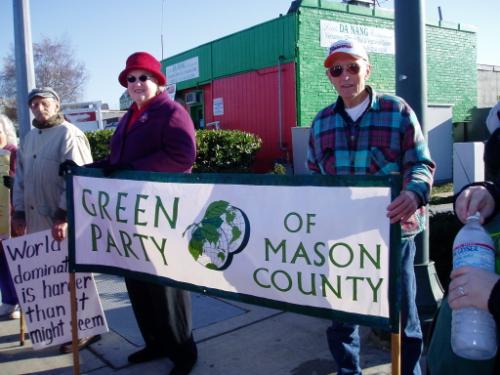
I don't know how many hearty souls braved the cold weather, but we filled about 2 city blocks with people standing up for peace. We even had the opportunity to meet some area Greens, including one from Grays Harbor County! (See photo taken by Bob Ziegler.)

Now we know that we won't have to organize Grays Harbor County by ourselves!

Tuesday, December 13, 2005

How 'Bout Them Jugs!

Any time an individual or family moves from one locale to another, there's a tendency to judge the new digs as opposed to the old domicile. Upon arriving in Aberdeen, one of the first things my wife & I looked at was the area's recycling program. How would it measure up to the program in good 'ol Salem, Oregon?

Salem's program, run in conjunction with Marion County, is a fairly good one. Co-mingled recycling is picked up curbside and the number of items eligible is laudable. You can put batteries, paint, plastic containers, newsprint, mixed paper, greyboard, cardboard, aluminum, tin cans, motor oil and several other items out at the curb for bi-weekly pick-up. If you have items that don't fall onto the curbside list, you are still afforded the opportunity to dispose of most anything else at 3 transfer stations positioned around town.

While Aberdeen does have a curbside recycling program, it pales in comparison to Salem's or even Olympia's (a mere 50 miles to the east). While the Salem program provides a huge recycling receptacle for each customer's use, Aberdeen provides 3 little bins. The blue bin is for glass. The light grey bin is for tin cans and aluminum foil. The beige bin is for newspapers.

Aberdeen also allows each customer to place at the curb two paper sacks filled with mixed paper and corrugated cardboard. Milk jugs can be recycled too, but each family must tote them to the transer station themselves.

That's it (except for some provisions for hazardous waste)! What strikes me as rather odd is that while milk jugs are eligible to be recycled, no other types of plastic bottle are. Thus, yogurt cups, drink bottles, shampoo containers go into the trash with lots of greyboard. And all this gets transported to the landfill.

I guess I should be thankful that Aberdeen recycles at all!

Sunday, December 11, 2005

Literal Rambling Leads to Writer's Block

For the 1st 6 months, I generally posted one or more entries per day on this blog. After that point, entries have become far more sporadic. Initially, this was the result of my impending Americorp*VISTA assignment. When that blew up in my face, I thought I'd return to my writings.

But a funny thing happened on the way -- My wife & I decided that since we were preparing to move [to Forks, WA], we would go ahead and move anyway with the only difference being our final destination. So, we up and decided to throw caution to the wind and we just completed a move to Aberdeen, WA.

Mind you, we don't know a soul in Aberdeen. We don't have any family here. We don't have new jobs lined up. No, we simply sold our house in Salem and found a nice house to rent in Aberdeen while we look for a house in the area to buy. In essence, we decided to do a little rambling.

Moving, particularly when one is older (more unneeded accumulation), is a time-consuming process. It leaves one little time nor energy to write. It's causes a sort of physical writer's block.

Hopefully, now that we're settling in, I can finally get back to daily writing.

Thursday, November 3, 2005

Dress Code

As I outlined in my last entry, I was unceremoniously bounced from the Americorp*VISTA program. What vile thing did I do to incur the wrath of my potential supporting organization and the regional office in Seattle? (If some children are afoot, PLEASE cover their eyes now!)

Overalls.

Yes, you read that correctly. O-v-e-r-a-l-l-s. I had the audacity to wear my overalls to an interview with a local reporter. Mind you, I was not yet an “official” representative of the VISTA program. I paid all the expenses to travel to Forks, Washington (though, as a peace offering, they’re now planning to reimburse me). The interview wasn’t a mandated requisite of my position; it was initiated at my behest and I was participating in the interview on MY own time.

Unfortunately, trying to promote the sponsoring organization, I invited my now erstwhile future supervisor, Bob, to join me. Though he said NOTHING negative during the interview or in our short meeting afterwards, it seems that my overalls sent him into a tizzy.

[Note: I wear overalls a lot. In fact, I wear overalls almost everyday. I like overalls because I have an almost nonexistent butt. Belts have never seemed to work for me – no matter how tight I pull them, my pants slide down past my flat bottom. I do have several nice pairs of suspenders, but I had already packed for shipment to Forks most all of my nice pants.]

In fact, when “Bob” and I parted, he suggested that I go introduce myself to several people in the community, if I had enough time left over from house hunting. Now, is this the kind of suggestion someone would make if they felt one’s manner of dress was inappropriate? Acting as my future supervisor, I would certainly think that Bob might say something like, “Do me a favor and make sure you change clothes before going out into the general community.”

But he said nary a word about my wardrobe choice. In fact, as stated above, he didn’t have anything negative to say to me at all. He complimented me on a fine interview with the local paper and then we talked briefly about house hunting and some ideas about my future VISTA project. We shook hands and he said something about contacting me the next week to discuss more project ideas.

My wife & I finally found a possible home and then returned to Salem the next day. Once home, I checked my email. And that’s when the hammer dropped. Bob sent me a vague note stating that I had been de-selected as his agency’s VISTA volunteer. He didn’t provide anything specific.

What irritated me to no end was the fact that he sent me this email less than 24 hours after our little meeting. He sent the message via email to my home 300 miles away DESPITE the fact that he knew which motel my wife & I were staying at. He sent the message via email while my wife & I were looking for a house to buy in Forks – an unneeded activity if we had no reason to move to Forks. It wasn’t until Monday afternoon (the email was sent on Friday morning and not read by me until Saturday night) that I finally reached Bob to learn that overalls played a part in this sudden about face.

Well, it wasn’t JUST overalls. It seems Bob also didn’t like the bumper stickers on my truck. I’ll discuss THAT aspect in the next entry.

Sunday, October 2, 2005

Two Wrongs

Growing up, I was taught that two wrongs don't make a right. I don't think this was a lesson passed down only in my family. I think a lot of families try to instill messages of this kind.

Lately, I'm beginning to wonder. It doesn't appear that Salem Mayor Janet Taylor or any of her merry men were taught such things.

Case in point -- Keizer Station. This new mega-development on the outskirts of Keizer is sure to hurt many Salem downtown businesses and Keizer businesses along River Rd. It will pull people away from each ciy's core which will mean more people driving more vehicles more often and for more miles. If all this wasn't bad enough, most of the stores that will populate Keizer Station are not local businesses, but big chains.

With all this in mind, one would think that the Salem City Council would decide to make a stronger commitment to downtown Salem to mitigate the future effects of Keizer Station. Unfortunately, the Council is discussing doing the EXACT opposite. Instead of focusing on downtown business, the Council has decided to consider putting a mega-development ACROSS I-5 from Keizer Station.

This would mean even more people driving more vehicles more often and for more miles away from our city's center and away from our shiny new convention center.

As national columnist Dave Barry often writes, I'm not making this up.

Thursday, July 14, 2005

Snippets from Off the Beaten Path

If you rely on your local newspaper or the 4 major networks or CNN for news, you're missing a great deal. While the rest of the world gobbles up a cornucopia of important information each day, folks who rely on this country's mainstream media are often treated to mere government regurgitations and fluff.

I thought I'd share with you some of the information I publish each week in the Salem CityWatch Digest. Aside from listing progressive programs and events in the Salem, Oregon area, I include sections which detail ways for area activists to get involved plus important articles in the alternative press.

Here are some snippets from the stories and columns of the past week or so that you may have missed:

Who's Watching the Watch List? -- AlterNet
My name is on a list of real and suspected enemies of the state and I can't find out what I'm accused of or why, let alone defend myself. And I'm guilty, says my government, not just until proven innocent or a victim of mistaken identity--but forever. [Note: This column is written not by a progressive activist but by an individual who, until this happened to him, was a staunch supporter of "Homeland Security".]
Class Consciousness Matters -- In These Times
The myth of the self-made man is American culture's own special heart of darkness, helping to explain both its infectious optimism and ruthless greed. The idea holds enough truth and seductiveness to make it easy to forget its delusional dangers. To reprise Marx's famous formulation, individuals, like humankind, do make their own personal history, but not under conditions they choose. But in America, we choose to ignore the caveat about conditions at our peril.
The Original Flag Desecration -- TomPaine
When the House of Representatives passed the proposed constitutional amendment against "flag desecration," the politicians struck a blow not for patriotism but government thought control. Yet, ironically, our poorly educated right-wingers have now set America on course to criminalize the displaying of the Confederate flag, an accident that will leave many of them confused and scrambling to rewind their opportunism.
Yelm Residents Forbidden to Mention Wal-Mart -- New Rules Project
Residents of the small town of Yelm, Washington, have been forbidden to utter the words "Wal-Mart," "big-box," or "moratorium" during City Council meetings. "For a long time citizens have not been coming forward to challenge what the city council has been doing," said Christine Hartman of the Yelm Commerce Group (YCG), which formed to oppose a planned Wal-Mart superstore. Now that citizens are speaking out at council meetings, Hartman said, "They resent this. They don't want to hear what we have to say."
Exporting American Values -- The American Prospect
In this week when we commemorate the first proclamation of American ideals to the wider world, we should pause to contemplate which of our ideals are taking root today. Consider, for instance, the very self-interested testimony of Fu Chengyu, the chief executive of CNOOC Ltd., the oil company owned by the Chinese government, which is currently endeavoring to buy Unocal Corp. "The Chinese people and government are learning from the U.S.," Fu told the Los Angeles Times last Friday. "We are adopting the free-trade system very quickly. . . . We are using U.S. bankers, advisors, exactly meeting the processes of U.S. market requirements" for mergers and acquisitions.
And here's an entire (great!) article:

Pile High, Sell Cheap & Pay Well -- The Financial Times (UK)
Look!" said the first little boy to walk by with his parents. "Awesome!" the next child, a little girl, said to her mother, pointing at a vast inflatable backyard paddling pool suspended from the warehouse ceiling.

At Costco's Kirkland warehouse outside Seattle, the pool dangling from the rafters was apparently delivering what Richard Galanti, the US retailer's chief financial officer, calls the "wow" factor - that extra bit of excitement that it wants to produce in order to draw visitors to its cavernous, no-frills warehouse stores.

"If we have a floating inflatable ring for towing behind a boat, it will be the biggest there is . . . it will be 10ft across . . . and it will only cost $49.99," Mr Galanti says, speaking with rapid enthusiasm in his modest office at Costco's headquarters in the nearby suburb of Issaquah.

But, in the world of US retail, it is not just Costco's "stack 'em high, sell 'em cheap" approach to higher quality items such as organic spinach and balsamic vinegar that merits attention.

In a country where the retail industry has been convulsed over the past decade by the rise of Wal-Mart and rival discounters, Costco's discount warehouse club is part of the revolution. But unlike Wal-Mart, whose low-cost labour model has provoked increasingly vocal criticism, Costco has managed to remain competitive while providing its workers with the highest wages and best healthcare plans available anywhere in the US retail industry.

In the anti-Wal-Mart camp, "Costco is seen as the White Knight to Wal-Mart's Darth Vader," says Nelson Lichtenstein, a University of California professor of labour history, who is editing a new book on Wal-Mart's rise.

Costco was founded by Jim Sinegal, chief executive and president, and Jeff Brotman, company chairman, in 1983 - the year that Sam Walton, founder of Wal-Mart, opened Sam's Club, a rival warehouse club.

Both follow the same broad philosophy, developed for small business operators, rather than for individual shoppers: sell a limited number of items in bulk to reduce handling overheads, use mass orders to win attractive pricing from ­suppliers and sell membership subscriptions to boost returns and guarantee customer loyalty.

At the Kirkland Costco on a Monday afternoon, shoppers pass the threshold every couple of seconds, flashing their $45 annual Costco membership cards at an employee at the door.

Inside, there are plasma screen TVs for $3,999.99, and three pounds of bananas for 99 cents. There are clothes piled on trestle tables, surrounded by warehouse steel stacks of goods.

All this is possible because Costco does not waste money on other things. There are no signs on the aisles and comparatively few staff, no money is spent on advertising, and there is no investor relations or communications department.

"Anything we can do to lower the expenses translates into being able to sell the merchandise for lower cost," says Mr Galanti. "So that we are the extreme value proposition for quality goods."

If membership fees of $960m are excluded, Costco made just $425m in operating profits from its sales of $47bn last year - less than one cent of every dollar it makes at the tills. Wal-Mart has an overall operating profit margin - which includes all its outlets, not just warehouse stores - of
around 5 per cent.

But Costco's frugality does not extend to pay and working conditions. The average hourly wage for a full and part-time US employee is $17.41, according to the company. At Wal-Mart's Sam's Club, the sum for a similar employee is around $12 an hour.

"It's important to pay people a fair living wage," says Mr Galanti, "and if you do, and it's better than everybody else, you're going to get better people - and they're going to stick around longer, and we see that." [emphasis added]

Costco has a staff turnover rate of 17 per cent annually, excluding seasonal hires, compared with 70 per cent seen in the rest of the sector. Only six per cent of new staff leave within the first year, which again reduces costs. "First and foremost, it's the right thing to do," says Mr Galanti. "And long-term, we know it pays dividends."

While Wal-Mart, Target and other US discounters have vigorously resisted union attempts to organise their workers, about 20 per cent of Costco's 84,000 US workers are members of the Teamsters union. Costco acquired the union-organised workers when it purchased Price Club's warehouses in 1993 - but, significantly, it has not sought to shun the unions.

"We prefer not to have them," admits Mr Galanti of the unions. "But we're not going to fight them. It's up to the employees to make that decision, not us."

Only one Costco warehouse has been organised by the Teamsters since 1993. But Roma Aloise, who heads the Teamsters Costco unit, says the company "has played it pretty straight-forward" during organising drives.

"Jim Sinegal believes in treating people right," Mr Aloise says of Costco's chief executive, who was a vocal supporter of John Kerry's 2004 presidential bid.

Wall Street has sometimes been less appreciative of Costco's high-wage model. In August 2003, the company's shares fell about 20 per cent after it reduced its earnings forecast, amid intensifying competition from Sam's Club and growing healthcare costs. Costco increased employee contributions to its healthcare scheme last year, easing some of the pressure on costs.

The company is also not immune to all the criticisms now being directed at Wal-Mart and Sam's Club. It rejects calls for independent monitoring of standards at its suppliers' factories. It is also fighting a would-be class action civil rights law suit alleging a pattern of discrimination against its women employees.

But, for all this, the price fight with Sam's Club continues. Like Wal-Mart, Costco pursues the goal of low prices with an almost religious zeal. It also maintains a strict limit on how much above cost price it will charge the customer - 14 per cent for branded goods and 15 per cent for its
own Kirkland brand products.

"We're extremely fanatical and disciplined about prices," says Mr Galanti, using the shirt he is wearing as an example.

Costco started selling the shirt, which Mr Galanti reckons would cost about $40 in a department store, in three colours under its Kirkland brand for $17.99. It was so popular that they went back with a new, even bigger order, and got a lower price.

"Overnight, we lowered the price from $17.99 to $12.99. Now, as CFO, I'm going: 'How about $14.99?' But that's not how it works."

"Our view is that that is how companies get in trouble in the retail business," he says. "They turn around one day and they are not as special as they used to be."

Costco and Sam's Club opened their first stores in 1983. But the concept of membership-based warehouse club shopping had been launched in the US by Sol Price, one of the great figures of 20th century American retail.

Mr. Price, now 89, was a pioneer of the US discount shopping retail revolution, opening a chain called Fed-Mart in California in the 1950s. After selling Fed-Mart, he and his son Robert opened the first Price Club discount store in a converted aircraft hangar in San Diego in 1976.

Jim Sinegal, Costco's joint founder, was one of Mr Price's protégés, and Wal-Mart's Sam Walton started Sam's Club after a visit to Mr Price in California. Mr Walton, who died in 1992 aged 74, acknowledged in his autobiography that he had borrowed "as many ideas from Sol Price as from anybody else in the business".

But unlike Mr Walton, Mr Price was always sympathetic to unions and believed in paying above-market wages, reflecting what Nelson Lichtenstein, professor of labour history at the University of California at Santa Barbara, says were his roots in the postwar order established by President Franklin D. Roosevelt's New Deal.

Robert Price is now chief executive of the family's latest warehouse venture, Price Smart, which operates stores in Central America, the Caribbean and the Philippines.

Saturday, July 2, 2005

No Distraught Mothers

Aside from the usual fireworks, one of the July 4 traditions in Salem is the annual civil war reenactment at nearby Willamette Mission State Park. Men and youth from throughout the region will don Union and Confederate uniforms to revel in the glory of America's one major internal conflict.

To be honest, I have mixed feelings about this annual event. On the one hand, I can certainly understand the desire to explore American history in a way that moves beyond the sterile treatment of a book, magazine article or movie. On the other hand, however, it pains me greatly that war is being celebrated and that participants bathe themselves in the supposed glory of it all without gaining a true understanding of the genuine misery and agony war brings to far too many soldiers and their families.

As a youth, one of my favorite subjects in school was history. It's a love I have carried with me throughout my life. One year during spring break in college, when most of my classmates were off engaged in the frivolities of young adulthood, I curled up for the week with a 700+ page work of author Alvin Josephy and his historical look at the Nez Perce Indians. (note: I'm a slow reader)

Many of the books and magazines I regularly read involve an examination of various periods of history. My two favorite cable networks are the History Channel and A & E, both filled with documentaries of an historical nature. And most of my favorite movies (e.g., The Last Samurai, Dances with Wolves, Finding Neverland, Field of Dreams, etc.) are steeped in the retelling of a specific historical event or period.

Consequently, I can readily understand why some people return to participate in this event year after year.

But a reenactment does an injustice to the ugliness of war. Participants are playing out sanitized versions of a dark reality. As reported in the Statesman Journal, "When the smoke cleared, the "dead" stood up, and the Union and Confederate Civil War reenactors returned to camp together." In other words, it turns a horrific event into a friendly social event.

By and large, soldiers on both sides of the War Between the States were ill-trained, ill-equipped, ill-fed, and ill-paid. (A significant number of them were poor, illiterate immigrants.) Field medicine was in its infancy. Soldiers injured in battle were often left on the battlefield for several hours or even a day or two to die in agony. Those that were carried from the field of battle often died as ill-trained medics tried to tend to their wounds.

From the historical documents of the day, we have learned that, for most soldiers, the Civil War was not glorious at all. It was a horrible experience.

And it certainly wasn't glorious for many families. Some towns lost the majority of their able-bodied men. Some families lost most or all of their adult males, leaving behind destitute and distraught mothers, wives and children.

None of these negatives can be felt nor experienced in a reenactment. It is for this reason -- despite the part of me that loves to dive head first into historical research -- that I'm sickened by events of this nature.

War should never be glorified.

Distraught mothers should never be forgotten.

Tuesday, June 7, 2005

What They Don't Say

According to the Capital Press, a regional weekly agricultural newspaper produced in Salem, a proposed labeling requirement in California is bad policy. Advocates want "consumers of french fries and other foods to know about acrylamide".

What is acrylamide? Is it a substantial health risk? Neither of these questions is addressed adequately in the editorial.

In fact, the only information that deals with acrylamide itself is contained in the repeated idea that it's "a naturally occurring compound that can be created when potatoes -- or many other foods -- are fried or cooked at a high temperature".

Instead of discussing the health concerns of this substance, the Capitol Press attacks the idea because it would be bad for business.
In this case, growers, processors and retailers stand to pay the price for labels that wonÂ’t protect the publicÂ’s well-being and distract residents from the important real business at hand.

It sounds like acrylamide is nothing to get in a tizzy about. Yet, according to the FDA,
A potentially cancer-causing agent used to manufacture certain chemicals, plastics, and dyes has recently been found to be a natural by-product of cooking certain foods. The Food and Drug Administration is taking a closer look at this white, odorless chemical, acrylamide, to determine how much of it occurs in foods and whether it could pose a health risk.

In April 2002, researchers in Sweden discovered that cooking at high temperatures could create acrylamide in many types of foods, particularly starchy foods such as french fries, potato chips, bread, rice, and processed cereals.

Scientists know that acrylamide causes cancer in laboratory rats. They also know that contact with large quantities of acrylamide can cause nerve damage in humans. But no one knows whether the tiny amounts of acrylamide in cooked foods can cause cancer or have any other harmful effects when ingested by people. "As soon as we heard about this problem, we took action and laid out a solid plan to learn more about acrylamide and to reduce exposure to it," says Terry Troxell, Ph.D., director of the FDA's Office of Plant and Dairy Foods and Beverages.

Some critics charge that the FDA is grossly understating the issue. As early as 2002, the Center for Science in the Public interest (CSPI) reported that "the amount of acrylamide in a large order of fast-food French fries is at least 300 times more than what the U.S. Environmental Protection Agency allows in a glass of water."

I don't know about you, but I like the idea of knowing what I'm shoving down my throat. If it has the potential for causing long term health issues, it would be nice to know this on the front end.

Consequently, I think the Capital Press has woefully missed the mark. Yes, labels may add some costs to certain products, but isn't our health and well-being worth the miniscule cost?

Thursday, May 26, 2005

Driving My Life Away

I've been on the road most of this week. In fact, I've spent a great deal of the past year driving around Oregon, Washington & Northern California (job hunting). I've noticed something odd. All of the crazy drivers seem to congregate in the Portland-Salem area of I-5.

I simply detest driving in or around Portland. No one drives any where near the speed limit, including the police. Drivers dart in and out of lanes as if being chased by demons. And, because most of them live in the area (meaning they have to put up with this insanity on a daily basis), far too many of them are ANGRY drivers.

Now don't think I'm musing about the all too typical rush hour mad scramble. I carefully plan my trips around Portland specifically to avoid rush hour. I will only travel through or around the Rose City from 9:30 a.m. - 2:30 p.m. or after 7:00 p.m., unless it's the weekend.

This week I drove the length of I-84 through Oregon. For hundreds of miles drivers were very sedate. It was only when I reached Portland and traveled on to Salem that I ran into the insane drivers.

I hope I get a job in Eastern Oregon. It will be great for my nerves.

Thursday, May 19, 2005

Making Headway

A lot of the time progressives wonder if we can genuinely make a difference in our communities. In this day and age of Bush and compassionate conservativism, this anxiety shows up most often in the electoral arena. We often wonder if its really possible to get bona fide progressive candidate elected to office.

If you've ever wondered this, the recent school board elections should provide you with a strong measure of hope. The five candidates endorsed by the Stand for Children Action Fund -- 3 in Portland and 2 in Salem -- each won their race. Please note that I'm not saying that 5 out of x number of the Fund's endorsements won -- EVERY candidate endorsed won!

In the southern Oregon town of Ashland, all 3 school board candidates endorsed by the Jackson County Pacific Green Party won too. Not only did they win -- two against incumbents -- but they all won with more than 60% of the vote! In Corvallis, another Green Party-endorsed candidate, Matt Donohue, beat the incumbent as well.

This clearly proves that we CAN win! But there are some secrets to this winning formula. First, candidates need to declare early. Second, candidates need to hammer on progressive themes. Third, candidates need to gather the endorsements of progressive groups AND those groups must provide the "foot soldiers" to get the word out far and wide.

The Salem City elections are less than 1 year away. The above results should galvanize our resolve to wrest control of our fine city away from Janet Taylor and the development interests that have choked off public participation. We can succeed in this endeavor IF we start to lay the groundwork now.

In other words, we need to roll up our collective sleeves and get to work.

Friday, May 13, 2005

$5 & a Can of Dog Food

Tonight, while out, I was approached by a homeless man and his dog. He asked me for some change so he could buy dog food. I gave him the few coins in my pocket.

I also had a $20 bill. I went to a local store here in Salem. I bought a can of dog food. I returned to give him the dog food plus a $5 bill.

In years past, I would have easily given the former, but not the latter. My worry about giving money to transients is that they might then use this donation to purchase alcohol or drugs. In this current situation, that assumption would be a good bet as this individual smelled of cheap alcohol and appeared quite tipsy.

My recent change of heart regarding monetary donations has come about because I've never been homeless. I don't know what it's like in the least. I'm certain it's a difficult way to survive and I wouldn't be surprised if it's even more stressful than NOT being homeless.

While I'm a big believer in the necessity of good (in my case, organic) food, who am I to say that food is the one thing this particular person needs at this given moment? Maybe a shot of whiskey or snort of whatever will allow this person to face another night of uncertainty in the cold under a nondescript bridge.

More importantly, I realized that, in my choice of a handout, I was judging people. I was trying to decide what was best for this stranger right now. Each time I waved away a plea for change and instead purchased a hamburger and/or a bag of chips to give to the person, I was imposing my will and beliefs upon them. That's not what they had requested and, regardless of their situation, it's not my place to confer such judgment.

All that said, I did STILL impose my will to a degree in this situation. To help insure the dog indeed would be fed, I specifically purchased a can of dog food (with a pull top, no less).

I realize the possibility exists that this man may eat the dog food himself. However, I think that is a remote possibility. In my past experience with homeless people with pets (generally dogs), I've often found that they treat their dogs better than they treat themselves. Their dogs are not only companions but provide them with a measure of protection. So, it's important to keep their protector happy AND fed.

I hope the dog had a good meal and the stranger used the money for what he felt he needed most tonight be it food, alcohol or whatever else.

Friday, May 6, 2005

Getting Out the Heavy Lumber

One would think that a multimillion dollar corporation (with offices around the country) would have better things to do than go after one solitary blogger out of Salem, Oregon. However, it seems I've riled up the big wigs at Linda Christas, a company that offers online tutoring services to middle and high school students.

THEY approached me about a job. I did a bit of online investigating and decided their offer looked like a scam. So, I wrote about my investigation on this very blog under the heading, "A Few Good Saps".

This made them very unhappy. It seems they don't like any dissent or criticism. They bombarded the comments for this post. (Interestingly enough, my tracking software indicates that the only way they seem able to FIND this entry on my blog was to conduct searches with Google and Yahoo. One would think that once they had arrived here, someone would think to add it to their favorites or bookmarks.)

In fact, various representives of Linda Christas (maybe just 1 or 2 people "posing" as a lot of people?) posted so many comments that this entry rose in the Google standings for searches for "Linda Christas" and "Linda Christas scam". Currently, the latter is ranked 5th.

In one of my comments, I pointed out this fact. I wrote that they were unwittingly doing more damage to their self-defined reputation than if they merely ignored my blog. Still, they left MORE comments. (Maybe Linda Christas doesn't teach analytical reasoning skills.)

Because THEY were making the "Saps" entry so popular, more and more people have read it. So, they decided they needed to devise a strategy to try to remove my criticism from the internet. They decided to file a Digital Millenium Copyright Act (DCMA) complaint against me for supposedly using copyrighted material.

Did I plagarize their web site? Have I violated the law?

What they are alleging was a copyright infringement was merely my quoting their website and saying I quoted their website. According to the Anti-DCMA website,
Copyright, in the United States, is an attempt to maximize the intellectual resources available to all. People who create works - literature, art, software programs, music, and others - are given a limited right to keep people from making unauthorized copies of their work. This allows them to sell copies for a profit and provides a financial incentive to create more works.

In exchange for this, the public demands a number of concessions, primarily the following three:

1. Fair use is the right to make unauthorized copies of works for certain protected purposes - mainly for academics, reporting, or criticism. When a student quotes a book in a high school paper, she is making a fair use, and can't be stopped by the copyright owner.

2. First sale is the right to sell a copy over and over again, once it is made, as long as you don't make any new copies. When you read a book, then sell it to a used book store to be bought and read by someone else, you're exercising your rights under first sale.

3. Limited time - copyrights are granted for a limited time. After that time expires, the work goes into the public domain - it can be copied and used by anyone, for any reason.

Since my post was a critique of their published work (I wasn't using it to make a profit for myself), it SHOULD be covered under exception #1. I'm sure Linda Christas is well aware of this fact, but why should law matter to be a big corporation? As the anti-DMC website states,
Unfortunately, this law is very poorly written, and is now regularly used by corporations to restrain the three primary concessions of copyright and otherwise prevent free speech activity.
In order to fight such a complaint, a blogger must file a counterclaim. Google provides an explanation of the process and, it should be noted, it can cost a pretty penny! Since I'm a cash-poor blogger and Linda Christas is a multimillion dollar corporation, they've basically decided to try to squash me with their economic might.

They may regret that decision.

Addendum: To read even MORE on this topic -- admit it, you just can't get enough -- go here.

Monday, April 18, 2005

Have Car, Will Speed

A recent article by the Associated Press, featured on KGW Newschannel 8's web site, discusses the connection between an increase in drivers who exceed the speed limit and a decrease in the number of state troopers on Oregon roads.
Oregon citations for speeding at 90 mph and faster have increased 4 percent during the past five years, during a period when the number of speeding tickets overall dropped by 30 percent. Complaints about aggressive driving, including tailgating and weaving in and out of traffic, also have increased. Speeding was the sole cause of 35 percent of all traffic fatalities in Oregon in 2003, the most recent year for which crash statistics are available. By contrast, alcohol was the sole cause of 25 percent of traffic fatalities. Seat belt use by drivers hovers around 92 percent. Experts cite numerous reasons for the jump in speeding: drivers in a hurry to get where they are going; modern car engineering creating a deceptively safe-feeling and quiet ride; and, in Oregon, fewer troopers on the road to enforce higher speed limits on some sections of the interstate. Washington state, for instance, with 1.7 times Oregon's population, has 2.7 times the troopers -- 658 to Oregon's 241.
I can certainly attest to the lack of a decreased presence of Oregon State Troopers. Over the past 6 months, I've traveled throughout Oregon, Washington and Northern California going to job interviews. In both Washington and California, I've seen numerous state troopers patrolling the roads.

However, after a recent trip from Salem to Klamath, California, I did not see one Oregon State Trooper while covering over 500 Oregon miles during daylight hours over two days time. Not one! (I saw 7 state troopers in California in an area of less than 100 miles.)

Is it any wonder then that more drivers speed through Oregon? If there's little chance of being ticketed, most drivers won't give a second thought to driving as fast as they can.

Friday, March 18, 2005

The Outdated Roadmap

Maps, in all their various forms, are what we rely on to make sense out of a sometimes jumbled world. Not only do we utilize maps to help us navigate from Point A to Point B to Point C, but we use them as well to provide definition to the societal landscape. Consequently, possessing a map that is accurate should be very important to each of us.

Imagine for a moment that you have entered The Twilight Zone. You find yourself sitting in your vehicle parked in front of the State Capitol building in Salem -- but you don’t recognize what it is or where you are. In the backseat are boxes of marionberries.

You seem to be the ONLY person in town. Everywhere you look, there is no movement of any kind. You happen to glance at the passenger’s seat. You notice a list sitting on top of a map. You grab the list and read the following: 4 boxes – Lincoln (General Store); 3 boxes – Eola (Inn); and 12 boxes – Corvallis (Public Library).

None of these towns sound familiar to you, so you grab the map. A giant star indicates where you are now and there is a highlighted line showing your general route. However, try as you might, you can’t find these 3 towns anywhere near your route or, for that matter, in this state called Oregon…

As it happens, the character in this story is befuddled because he/she is looking at a map from 1850. In that year, the town known today as Lincoln was called Doaks Ferry. Eola today is an area, not a town, but in 1850 it was the thriving hamlet of Cincinnati. And, in its earliest days, the town that we now call Corvallis was known as Marysville.

As time marches forward, things change. Rivers alter their course and cut new channels. Natural and manmade disasters modify the landscape. Towns and industries thrive, only to disappear. What was once farmland located miles outside of town is soon swallowed up by the growing metropolis.

If your map doesn’t stay current with the inherent changes of civilization, you will have a difficult time navigating from place to place. But what’s even worse is the person who is shown that their map is inaccurate and yet they cling to it like the Holy Grail.

For me, this is an apt description of almost every religion. The map of their belief system was etched in stone hundreds or thousands of years ago. Each may well have described and explained in perfect form the landscape of their day. But we no longer live in THAT time and yet millions of people cling to these inaccurate directions.

Like a person trying to find Corvallis on a map that only shows Maryville, so many of these people are lost in the world and can’t figure out why.

It’s simple. Their map is woefully outdated.

Hey, to check out another perspective on this general theme, I recommend you visit Brian Hines' blog, Church of the Churchless, and his post Why Don't Religions Evolve?